I don't know from where I heard "Happy Testing", the first time and fear to think if it echoed within me. I also don't know how I caught those words to sign all my e-mails to testers I communicate, writing "Happy Testing" at the end of the e-mail. I noticed that a lot of other testers to whom I communicated also started doing that in their e-mail communication to me and in their blog posts. I didn't know what "Happy Testing" meant when I started using it long back but I think this post explains what I mean by Happy Testing.
For the moment, forget about people ( that includes me ) asking you to do good testing, better testing, great testing, pleasing customers, pleasing managers, and getting great hike. Think about doing happy testing.
As a tester what makes me happy is when I find 'a' bug. What makes me more happy is when I find more than a bug. What makes me the happiest is when I find more and more bugs in every product I test.
I come across a lot of Sad testers and observe a pattern of the bugs they find. Most Sad testers that I come across are the ones who follow test scripts or cases to find bugs. You might observe that those Sad testers say "These test cases found those bugs". I am sure if test cases have life, they would be happy set of organisms because a lot of Sad testers owe credit to the test case for whatever bugs they ( humans ) find.
Its not that those Sad testers are always unhappy about the bugs they find, its that they are happy and not happy enough to recognize how they can be more happy.
If finding a bug doesn't make you happy, how sad a tester you are!
Don't ask me the secret of being a "Happy Tester". I am sure a lot of Sad testers won't believe my reply, "Rapid Software Testing, Exploratory Testing and Context Driven Testing that provides me freedom to think, experiment and find a lot of bugs".
In every Skilled Exploratory Testing corporate workshop I do, I challenge testers on testing their product for 90 minutes and find a lot of bugs within that short span. One of the recent experience was in SAS, Pune, where testers started clapping after the 90th minute witnessing the Happy Testing I did. It felt like a Hero to receive clapping from testers for demonstrating Rapid Software Testing.
What I heard from Rajesh K , one of the managers who nominated his team and attended the workshop in SAS over an e-mail was "The bug count has certainly gone up". Happy Testing Rajesh, Vikram, Manoj Nair and their teams.
Jerry Weinberg revamped his website recently and a sentence in his revamped website made me think what Jerry was trying to say and here is the sentence for you "Dedicated to Helping Smart People be Happy". It made me wonder if smart people can be unhappy. I then thought about all those talented testers in India ( and probably other countries, too ) who have been forced to write and execute test cases and follow best practices that might have worked for someone else. That reminds me to say, I get happy when I read Jerry Weinberg's books because reading his work makes smart and I made myself a lot happier when I bought Jerry's books for about 300 US dollars during my trip to Canada.
Speaking of all that, let me ask a question to myself: Am I never unhappy?
Oh yes, whenever I come across people who are unhappy and they don't want to listen to stuff that can make them realize they are smart and can be happy enough, too.
Am I talking as though I am Mr Perfect?
Oh well, I forgot to share with you that an important lesson I learned is that - Humans are fallible and so are their ideas. Everything is a heuristic and it is a choice of heuristics in a suitable context that makes a person smart. If you think Perfect Software and Software Testing is possible, read Jerry Weinberg's Perfect Software and other Illusions about Testing.
Unfortunately, I want so see those sad testers I come across as happy as me. Unfortunately, they aren't happy that I am claiming to be happy by doing things that they think is impractical or hard.
Fortunately there are some sad testers who are smart and want to be more happy. I live to help them. Oh! Did I forget to tell you that I get happy when I help testers find more bugs.
-- Pradeep Soundararajan - http://testertested.blogspot.com - +91-98451-76817 - pradeep.srajan@gmail.com
"The test doesn't find the bug. A human finds the bug, and the test plays a role in helping the human find it." --
Wednesday, August 20, 2008


Friday, August 08, 2008
Testing to avoid being sued or embarrased
North American, European Union and some Asian countries laws and law enforcements are much stricter than those in India. Most testers in India who have not known much about it, tend to ignore that fact while they test. I too didn't know till I actively kept reading. The value of reading is - I know to focus on problems that matter to my clients in countries like North America.
You might want to know that the cost of being sued is heavy on the organizations. All investment on a product and estimated profits go for a toss on that single day of verdict. Organizations like Microsoft, Apple, Sony and a lot of them have suffered losses by being sued or have withdrew released products on the fear of being sued.
As usual, I was browsing through Orkut today [ 8th August 2008 at 14:00 hours ] and recognized a problem. Please go through the following screen shot carefully before you read further.

One of the newly introduced feature from Orkut is an option to let friends know what I am updating in my profile and vice versa. A friend of mine hadn't added his gender in his orkut profile since he created the profile . He probably decided to do it yesterday.
What I ( and you ) see as an update is "XYZ updated gender". Well, he just added his gender and nothing else.
An update of Gender column could mean, "I have changed my gender" - which sounds absurd or might offend people to know that their friends are thinking that he changed his gender or their friends are thinking that she changed her gender.
This might invite trouble to Orkut or Google if there exists a law in any country that organizations should not mislead or misinform about one's gender. If there exists such a law in any country then they might be susceptible to be sued for showing something that mentally hurt one's gender status amongst their friends and other society members to whom the profile is visible. It also causes a lot of embarassment to someone whose friends make a joke of him/her updating "gender".
Orkut has been in news all over India after people claimed it responsible for being a channel for pranksters who even ended up killing for money and a lot of other cases. What if someone attempts a suicide attempt and blames it on Orkut saying "I could not withstand the embarrassment of my friends asking about my gender".
Do you think its worth Google's time to fight such cases?
Do you also think such problems can be found by test case base approach?
Minutes before I was planning to post this, I thought of getting this post tested from Ben Simo and Jonathan Kohl. Ben Simo shared with me that Facebook came out with some gender issues recently.
A lot of other testers might have seen the problem that I highlighted in this post while they were browsing Orkut, why didn't they find it?
Answer Ben's question to find out the answer to above question : Will you recognize a problem if you see it?
--
Pradeep Soundararajan - http://testertested.blogspot.com - pradeep.srajan@gmail.com
You might want to know that the cost of being sued is heavy on the organizations. All investment on a product and estimated profits go for a toss on that single day of verdict. Organizations like Microsoft, Apple, Sony and a lot of them have suffered losses by being sued or have withdrew released products on the fear of being sued.
As usual, I was browsing through Orkut today [ 8th August 2008 at 14:00 hours ] and recognized a problem. Please go through the following screen shot carefully before you read further.

One of the newly introduced feature from Orkut is an option to let friends know what I am updating in my profile and vice versa. A friend of mine hadn't added his gender in his orkut profile since he created the profile . He probably decided to do it yesterday.
What I ( and you ) see as an update is "XYZ updated gender". Well, he just added his gender and nothing else.
An update of Gender column could mean, "I have changed my gender" - which sounds absurd or might offend people to know that their friends are thinking that he changed his gender or their friends are thinking that she changed her gender.
This might invite trouble to Orkut or Google if there exists a law in any country that organizations should not mislead or misinform about one's gender. If there exists such a law in any country then they might be susceptible to be sued for showing something that mentally hurt one's gender status amongst their friends and other society members to whom the profile is visible. It also causes a lot of embarassment to someone whose friends make a joke of him/her updating "gender".
Orkut has been in news all over India after people claimed it responsible for being a channel for pranksters who even ended up killing for money and a lot of other cases. What if someone attempts a suicide attempt and blames it on Orkut saying "I could not withstand the embarrassment of my friends asking about my gender".
Do you think its worth Google's time to fight such cases?
Do you also think such problems can be found by test case base approach?
Minutes before I was planning to post this, I thought of getting this post tested from Ben Simo and Jonathan Kohl. Ben Simo shared with me that Facebook came out with some gender issues recently.
A lot of other testers might have seen the problem that I highlighted in this post while they were browsing Orkut, why didn't they find it?
Answer Ben's question to find out the answer to above question : Will you recognize a problem if you see it?
--
Pradeep Soundararajan - http://testertested.blogspot.com - pradeep.srajan@gmail.com
Wednesday, July 30, 2008
Most test cases fail
- Most testers who write test cases carry a hope that most test cases they write would help in finding most bugs.
- Most testers who execute them carry a hope that most test cases they execute would help in finding most bugs.
- Most testers who add more test cases carry a hope that they will help in finding most bugs.
- Most managers who ask testers to write test cases carry a hope that their testers will catch most bugs with the help of test cases.
- Most managers who asked them to write test cases ask a question: How many test cases passed? when considering to ship.
- Most testers in those contexts reply, "Most".
"If a test case didn't help in finding a bug then the purpose of that test case failed. Products are shipped when most test cases fail their purpose of existence."
------------------------------------------------------------------------------------------------------------------------------------------
- Test cases fail to help most testers who write and execute them realize that testing is not a monotonous job as they are doing.
- Test cases fail to help most testers realize that there are other ways to achieve what they are trying to achieve or there are other ways to do much better testing.
- Test cases fail to help most managers understand that the number of test cases passed is a misleading metric because most test cases means few documented tests from a possible hundred billion tests.
- Test cases fail to help most customers understand that there are ways to gain more value for the cost they are paying.
- Test cases fail to help testers earn more money because in scripted testers view - an expert tester is one who writes a lot of test cases and executes a lot of test cases.
Test cases are human ideas and all human ideas can fail. Most testers who write and execute it fail to realize it.
If human ideas to test can't fail so will the software, not fail. Don't test.
If human ideas to test can't fail so will the software, not fail. Don't test.
------------------------------------------------------------------------------------------------------------------------------------------
To participate ( or just enjoy ) in a discussion involving exploratory and scripted testers on test cases , click here .
-- Pradeep Soundararajan - http://testertested.blogspot.com - pradeep.srajan@gmail.com
"The test doesn't find the bug. A human finds the bug, and the test plays a role in helping the human find it." --
Update: The comments posted as Angel and Devil are by me ( Pradeep Soundararajan ). Wondering why I posted comments on the post I wrote - you would know the answer if you go through those comments.
The Angels and Devils concept in Testing is inspired by a presentation from Michael Bolton and Jonathan Kohl . Here is an excerpt of the presentation and also illustrates Elizabeth Kohl's design skills.
Monday, July 21, 2008
Heroes of software testing - Do you know about them and their work?
My initial plan was to board the flight to Toronto on July 11th from Mumbai to attend CAST 08 software testing conference. Sangeeta, a tester from Mumbai influenced me to change my plan and organized a lecture in Ness Technologies in Mumbai.
I liked the offer and accepted it, as I knew I would enjoy the experience. It's fun to meet new testers, talk to them and learn new things. I am in constant search for budding testers like Sharath Byregowda , Ajay Balamurugadas , Sathish Kumar Chinappa , Sangeeta, Sandesh , Girija, Bhargavi and Nattu ( who accompanied me to CAST 08 ) and those who are passionate and do things about seeing a better tester community like Mohan Panguluri, COO of Edista Testing ... I never know where I can find similar ones. One of the ways that has been of great help to me, to find such testers and thinkers is, while at lectures and my workshops. I offer whatever help I am capable of doing to expose them to good stuff and I do it when they ask me for it.
Reading good stuff as a bad practice and reading bad stuff as the best practice
The above state is what most Indian testers to my knowledge are stuck in. This state resulted because most of testers don't have the habit of reading as though its a bad practice. Most of those who read, are the ones who search in Google and land up at bad sites ( that includes my blog at times ). Most of those who Google search are the ones who are not interested at better thought process but at ready made best practice answers.
There are good and great stuff from internet. I once searched for expert testers and found James Bach. That google search changed my life and the way I test. There were a lot of junk stuff written to attract such search results that I had to pass through before finding James Bach's website. I was sure that I needed help about thought process from an expert tester and not ready made solutions from time to time.
The road to Toronto
I had to face a lot of trouble to get to Toronto. My Visa was rejected ( at the first attempt ), I didn't have sufficient funds ( as per the VISA officials and my bank statement ) , I was denied permission to board the plane as my ticket was booked via United States and I didn't have a US Visa. The Canadian customs had a discussion that bothered me if they would let me in after I landed at Toronto and then my baggage went missing and finally landed as the last one on the belt. Amidst all this was my hope to meet the heroes in real space who have inspired me and to meet those whom I can draw more inspiration from. I believe in God and also believe that God takes a human form to help humans. A great human who lives in 61, Ashburnham in Toronto and the one who lived in my house ( my dad ) helped me and cleared traps so that I reached Toronto and was able to attend CAST 08.
Chasing dreams
Finally I got a chance to meet the heroes who have been inspiring me to test and think better. My super hero James Bach wasn't present at the conference and hence I couldn't meet him. I would be meeting him in November at a conference where we both are invited to speak on testing at a developers conference in Malmo Sweden.
By meeting my heroes, I learned some important things that I could not have learned, had I not met them. I got an insight into the way they live, some ways they think and they communicate. It was several dreams of several years that came true, all in one place - CAST 08.
Not all learning is fun.
If you have understood what I have written in this post so far, then my English writing skill has improved a lot since I wrote my first blog post. It pained a lot to know that I was writing terribly bad English but had I not learned it, I wouldn't have been able to make sense to you in this post.
One of the important things I learned in CAST is the cost of making a few mistakes and the cost of wasting someone's time. I did some mistakes a few months ago but experienced the cost of making those mistakes when I could not stand in front of those people whose time I had wasted. I felt too ashamed of myself but I know I would not feel ashamed for a life time as I am recovering from those mistakes.
Learning is fun as long as you don't learn about yourself and how bad you are in somethings that you want to be really good at. The more I learn that I am bad, I am inspired to work hard enough to get over it. Being a student of James Bach means I keep searching for the answer, "How do I know what I know?" and often I discover what I don't know when I meet and discuss with great minds like the ones I met in CAST 08. I make it a practice to learn what I don't know or what more I'd want to learn on what I want to be good at.
Not all pain is bad
I went all way from Bengaluru ( Bangalore ) to Toronto to know more about myself and how bad I am in things I want to be good at. It hurts but there is no short cut to learning. For those who might disagree that learning could hurt - as testers we provide information about the quality of the product to the management. If we find a lot of bugs, it might hurt the management when they know it especially when it upsets their shipping schedules. It hurts them because they have learned something about their own product. This pain is then converted to measures to not get into a similar situation again. That is what I think some great man said, "No pain, No gain". The things that I learned from my heroes at the conference and other discussions would be reflected in my blog for years to come, so unfortunately keep reading them.
Person dependent software projects and organization
India depended on Sachin Tendulkar for winning a lot of matches. Cricket ( a team sport ) became a person dependent one. Is it a problem for Sachin?
Not really. Actually it demanded him to be at a very good knock and he loved that challenge as it challenged its consistency. It could also be stated that - he faced tough situations and cleared balls beyond boundaries which is why he is admired by millions worldwide.
Similarly, if your organization doesn't want to make their testing a person dependent thing it is because they don't like you to be Sachin Tendulkar . They can't stop from you becoming a Sachin of software testing because it depends on your learning as a tester and not they giving a learning opportunity to you.
You will be interested to read what James Bach wrote about the need for super heroes for software projects long back.
--
Pradeep Soundararajan - http://testertested.blogspot.com - +91-98451-76817 - pradeep.srajan@gmail.com
"The test doesn't find the bug. A human finds the bug, and the test plays a role in helping the human find it." --
I liked the offer and accepted it, as I knew I would enjoy the experience. It's fun to meet new testers, talk to them and learn new things. I am in constant search for budding testers like Sharath Byregowda , Ajay Balamurugadas , Sathish Kumar Chinappa , Sangeeta, Sandesh , Girija, Bhargavi and Nattu ( who accompanied me to CAST 08 ) and those who are passionate and do things about seeing a better tester community like Mohan Panguluri, COO of Edista Testing ... I never know where I can find similar ones. One of the ways that has been of great help to me, to find such testers and thinkers is, while at lectures and my workshops. I offer whatever help I am capable of doing to expose them to good stuff and I do it when they ask me for it.
Here is an excerpt from the talk:
"We are in India, the land where cricket is considered close to being a religion. It has super heroes like Sachin Tendulkar and Dhoni who have inspired a lot of people in India to play better cricket. They could inspire because a lot of people spent their time watching them play great cricket at tough situations. As Indians, you might have seen a lot of people who enjoy playing cricket the way Sachin and Dhoni play. As testers, have you seen anyone doing testing that has inspired you to test better?"
Response: Silence
and then a question comes up from a corner, "Who did Sir Don Bradman see as an inspiration for he is the best known cricketer of centuries?" and all other testers burst to laughter thinking that I was cornered with that question.
I took a while for the audience to settle down and replied,
"I know who inspired Sir Don Bradman" and then a pause to add, "It was himself."
"How many of you are inspired by your own testing?"
Response: Silence
End of excerpt
"We are in India, the land where cricket is considered close to being a religion. It has super heroes like Sachin Tendulkar and Dhoni who have inspired a lot of people in India to play better cricket. They could inspire because a lot of people spent their time watching them play great cricket at tough situations. As Indians, you might have seen a lot of people who enjoy playing cricket the way Sachin and Dhoni play. As testers, have you seen anyone doing testing that has inspired you to test better?"
Response: Silence
and then a question comes up from a corner, "Who did Sir Don Bradman see as an inspiration for he is the best known cricketer of centuries?" and all other testers burst to laughter thinking that I was cornered with that question.
I took a while for the audience to settle down and replied,
"I know who inspired Sir Don Bradman" and then a pause to add, "It was himself."
"How many of you are inspired by your own testing?"
Response: Silence
End of excerpt
Reading good stuff as a bad practice and reading bad stuff as the best practice
The above state is what most Indian testers to my knowledge are stuck in. This state resulted because most of testers don't have the habit of reading as though its a bad practice. Most of those who read, are the ones who search in Google and land up at bad sites ( that includes my blog at times ). Most of those who Google search are the ones who are not interested at better thought process but at ready made best practice answers.
There are good and great stuff from internet. I once searched for expert testers and found James Bach. That google search changed my life and the way I test. There were a lot of junk stuff written to attract such search results that I had to pass through before finding James Bach's website. I was sure that I needed help about thought process from an expert tester and not ready made solutions from time to time.
The road to Toronto
I had to face a lot of trouble to get to Toronto. My Visa was rejected ( at the first attempt ), I didn't have sufficient funds ( as per the VISA officials and my bank statement ) , I was denied permission to board the plane as my ticket was booked via United States and I didn't have a US Visa. The Canadian customs had a discussion that bothered me if they would let me in after I landed at Toronto and then my baggage went missing and finally landed as the last one on the belt. Amidst all this was my hope to meet the heroes in real space who have inspired me and to meet those whom I can draw more inspiration from. I believe in God and also believe that God takes a human form to help humans. A great human who lives in 61, Ashburnham in Toronto and the one who lived in my house ( my dad ) helped me and cleared traps so that I reached Toronto and was able to attend CAST 08.
Chasing dreams
Finally I got a chance to meet the heroes who have been inspiring me to test and think better. My super hero James Bach wasn't present at the conference and hence I couldn't meet him. I would be meeting him in November at a conference where we both are invited to speak on testing at a developers conference in Malmo Sweden.
By meeting my heroes, I learned some important things that I could not have learned, had I not met them. I got an insight into the way they live, some ways they think and they communicate. It was several dreams of several years that came true, all in one place - CAST 08.
Not all learning is fun.
If you have understood what I have written in this post so far, then my English writing skill has improved a lot since I wrote my first blog post. It pained a lot to know that I was writing terribly bad English but had I not learned it, I wouldn't have been able to make sense to you in this post.
One of the important things I learned in CAST is the cost of making a few mistakes and the cost of wasting someone's time. I did some mistakes a few months ago but experienced the cost of making those mistakes when I could not stand in front of those people whose time I had wasted. I felt too ashamed of myself but I know I would not feel ashamed for a life time as I am recovering from those mistakes.
Learning is fun as long as you don't learn about yourself and how bad you are in somethings that you want to be really good at. The more I learn that I am bad, I am inspired to work hard enough to get over it. Being a student of James Bach means I keep searching for the answer, "How do I know what I know?" and often I discover what I don't know when I meet and discuss with great minds like the ones I met in CAST 08. I make it a practice to learn what I don't know or what more I'd want to learn on what I want to be good at.
Not all pain is bad
I went all way from Bengaluru ( Bangalore ) to Toronto to know more about myself and how bad I am in things I want to be good at. It hurts but there is no short cut to learning. For those who might disagree that learning could hurt - as testers we provide information about the quality of the product to the management. If we find a lot of bugs, it might hurt the management when they know it especially when it upsets their shipping schedules. It hurts them because they have learned something about their own product. This pain is then converted to measures to not get into a similar situation again. That is what I think some great man said, "No pain, No gain". The things that I learned from my heroes at the conference and other discussions would be reflected in my blog for years to come, so unfortunately keep reading them.
Person dependent software projects and organization
India depended on Sachin Tendulkar for winning a lot of matches. Cricket ( a team sport ) became a person dependent one. Is it a problem for Sachin?
Not really. Actually it demanded him to be at a very good knock and he loved that challenge as it challenged its consistency. It could also be stated that - he faced tough situations and cleared balls beyond boundaries which is why he is admired by millions worldwide.
Similarly, if your organization doesn't want to make their testing a person dependent thing it is because they don't like you to be Sachin Tendulkar . They can't stop from you becoming a Sachin of software testing because it depends on your learning as a tester and not they giving a learning opportunity to you.
You will be interested to read what James Bach wrote about the need for super heroes for software projects long back.
--
Pradeep Soundararajan - http://testertested.blogspot.com - +91-98451-76817 - pradeep.srajan@gmail.com
"The test doesn't find the bug. A human finds the bug, and the test plays a role in helping the human find it." --
Monday, June 30, 2008
It's a "tester" who finds a bug, even with the robust Google Search
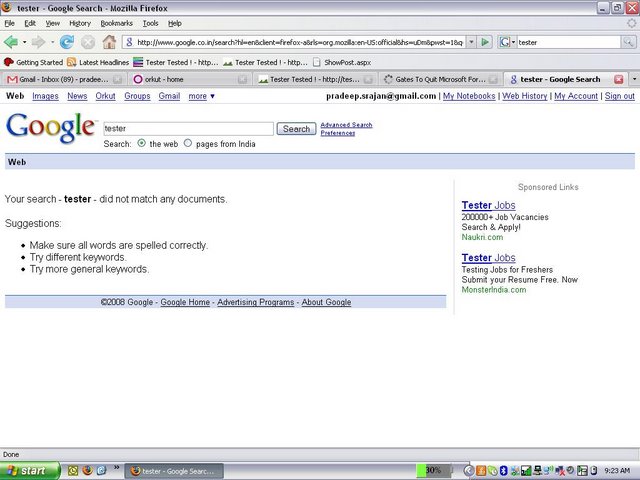
The image you might see above is a screen shot of what I saw after hitting the 12th page for the search results of "tester". I am not sure if you can reproduce that because I haven't investigated on it but I did plan to capture it to demonstrate:
"The test doesn't find the bug. A human finds the bug, and the test plays a role in helping the human find it."
Be it with the robust systems like Google Search Engine or with weak systems that we might be using, it is always a HUMAN who finds a bug. A lot of testers I know think of "test case" finding a bug.
There is a test case document that consists of 9856985956895869698569956985698459698 test cases and no tester executing it wouldn't find bugs by itself. There is a test case document with 3 documented tests and a tester takes the help of that to find bugs when he executes, observes the result and recognizes a bug.
A test case is an extension of a test idea. What matters to a tester is a test idea and not the test case. Skilled (exploratory testers ( humans ) use tons of ideas ( heuristics and oracles ) to find and recognize bugs. That's why they can find more bugs that matter than those running thousands of test cases over and over again.
Honestly, 99% of testers I have come across didn't say - "I read each test case each time I have to execute it after I have done it once. Also, I religiously follow what is written in the test case".
What happens when they deviate from the documented test case is, they are exploring and running different test. Maybe they don't like to call it that way because their management who pays wouldn't like to know that they are not executing the "test cases".
That's how customers are fooled by management saying "yes, we are running test cases" and yet benefited by the testing community by running more tests.
A test idea can be executed in hundreds of different ways. Check out the deep analysis made by James Bach and Michael Bolton on What Do Scripts Tell Us?
--
Pradeep Soundararajan - http://testertested.blogspot.com - +91-98451-76817 - pradeep.srajan@gmail.com
"The test doesn't find the bug. A human finds the bug, and the test plays a role in helping the human find it." --
Tuesday, June 17, 2008

Friday, June 06, 2008
Letter to myself
Dear Pradeep,
Greetings!
I have been with you all this while and shall continue to be with you. I am enjoying each moment you enjoy as a tester and also each moment that you don't enjoy as a tester. I am sorry for enjoying those moments which you think you haven't been enjoying. I am sure you'd be interested to know why and how I have been enjoying those moments that you haven't been.
First, let me list the thing that you haven't been enjoying:
I also remember that you had made a note in your Moleskine of Saurav Ganguly's television interview where he was asked: How were you able to make a great comeback to the world cup cricket squad after being axed for poor performance? His answer: I didn't worry about things that are not under my control ( media critique, jokes on bad batting performance, e-mail forwards about my performance, people gossiping about it ) but focussed on things that are under my control ( Practice, skill enhancement, consistent batting record in Ranji trophy)
Similarly, you don't have a control over the thoughts of people thinking whatever they think after reading whatever you have written. You have a control over what you write and you have a control over the way you write it.
Your testing has been influenced by a lot of experts but not all have similar influence. They haven't seen great testing to appreciate the things you are sharing and I doubt if all those who witness it would be influenced by it because it's hard work and high skill demanding.
Here are three questions ( like the Monty Python and the Holy grail bridge of death piece you enjoy )
1.Whom are you serving through your writing?
I am sure your ongoing struggle is in understanding that. Let me help you with what I think about whom you are serving - You are serving those testers who look for better thought process and those who enjoy the better thought process and those who think you have a better thought process.
2. Who asked you to serve them?
I asked you to do that!
3. Why haven't you been enjoying some moments that I have been?
You want all testers to do great testing although you know its not possible. Some people question your idea of "great testing" because they already have an idea of "great testing" and it conflicts with the idea you have. You are able to demonstrate that their idea of "great testing" lacks critical thought as your idea of "great testing".
By the way, your idea of "great testing", is not yours but of those people who have influenced you. You have just subscribe to those ideas and are contributing to it in different forms. I have occasionally witnessed you doing bad testing and I am sure I would see that in future, too. Do not forget that you are a human and your ideas are fallible. I know bad testing and bad thought process irritates you, even if you are the one who is doing it.
I would love to see you doing things that are under your control - learning, reading, writing, bettering your skills, helping those testers who enjoy the thought process that you enjoy, speaking, coaching and mentoring.
Your power to influence testers is limited. Limited to the ones who don't want to limit themselves. So do unlimited things under limited time that you and I will be here in this world.
I will be with you forever, enjoying everything you do from great things to not so great things. Anything you do is great to me.
I will write to you whenever I feel a need for it. This letter is personal, just between you and me.
Yours truly,
--
Pradeep Soundararajan - http://testertested.blogspot.com - +91-98451-76817 - pradeep.srajan@gmail.com
"The test doesn't find the bug. A human finds the bug, and the test plays a role in helping the human find it." --
Greetings!
I have been with you all this while and shall continue to be with you. I am enjoying each moment you enjoy as a tester and also each moment that you don't enjoy as a tester. I am sorry for enjoying those moments which you think you haven't been enjoying. I am sure you'd be interested to know why and how I have been enjoying those moments that you haven't been.
First, let me list the thing that you haven't been enjoying:
- Whenever and wherever you write about test automation, a handful of readers tend to think that you reject the idea of test automation and they write harsh e-mails to you.
- Whenever and wherever you write about certification, the certified tester community attacks you over e-mails/phone calls that you and I are spoiling the craft.
- Whenever and wherever you write about programming skill for testers, another handful readers think that you are suggesting testers not to learn programming.
- Whenever and wherever you write about tools, most testers think you are referring to test automation tool.
- Whenever and wherever you write about yourself or your experience, a set of people think you lack humility.
- Whenever and wherever you write about exploratory testing as a skilled activity, a set of people think "no tester would do be able to do that".
- Whenever and wherever you write about ideas to solve a problem than giving a one line answer, a set of people think you don't know how to solve it and is faking what you know.
- Whenever and wherever you are writing about testing being an excellent thinking job, a few people think you are trying to paint a picture that does not exist.
- Whenever and wherever you - do bad testing, fail in testing course like BBST, you feel intimidated by more skilled people than you, you feel bad about not having learned or practiced those things that helps you become a better tester, you fail to give enough respect to expert testers time, etc...
I also remember that you had made a note in your Moleskine of Saurav Ganguly's television interview where he was asked: How were you able to make a great comeback to the world cup cricket squad after being axed for poor performance? His answer: I didn't worry about things that are not under my control ( media critique, jokes on bad batting performance, e-mail forwards about my performance, people gossiping about it ) but focussed on things that are under my control ( Practice, skill enhancement, consistent batting record in Ranji trophy)
Similarly, you don't have a control over the thoughts of people thinking whatever they think after reading whatever you have written. You have a control over what you write and you have a control over the way you write it.
Your testing has been influenced by a lot of experts but not all have similar influence. They haven't seen great testing to appreciate the things you are sharing and I doubt if all those who witness it would be influenced by it because it's hard work and high skill demanding.
- Not all testers want to do great testing
- Not all testers know they are doing bad testing.
- Not all testers want to know they are doing bad testing.
- Not all testers want to know more about testing.
- Not all testers know what skills to gain and practice.
- Not all testers agree to be context driven.
Here are three questions ( like the Monty Python and the Holy grail bridge of death piece you enjoy )
1.Whom are you serving through your writing?
I am sure your ongoing struggle is in understanding that. Let me help you with what I think about whom you are serving - You are serving those testers who look for better thought process and those who enjoy the better thought process and those who think you have a better thought process.
2. Who asked you to serve them?
I asked you to do that!
3. Why haven't you been enjoying some moments that I have been?
You want all testers to do great testing although you know its not possible. Some people question your idea of "great testing" because they already have an idea of "great testing" and it conflicts with the idea you have. You are able to demonstrate that their idea of "great testing" lacks critical thought as your idea of "great testing".
By the way, your idea of "great testing", is not yours but of those people who have influenced you. You have just subscribe to those ideas and are contributing to it in different forms. I have occasionally witnessed you doing bad testing and I am sure I would see that in future, too. Do not forget that you are a human and your ideas are fallible. I know bad testing and bad thought process irritates you, even if you are the one who is doing it.
I would love to see you doing things that are under your control - learning, reading, writing, bettering your skills, helping those testers who enjoy the thought process that you enjoy, speaking, coaching and mentoring.
Your power to influence testers is limited. Limited to the ones who don't want to limit themselves. So do unlimited things under limited time that you and I will be here in this world.
I will be with you forever, enjoying everything you do from great things to not so great things. Anything you do is great to me.
I will write to you whenever I feel a need for it. This letter is personal, just between you and me.
"Here is a way to test if your mission on earth is complete - if you are alive, it isn't" -- Richard Bach
Yours truly,
--
Pradeep Soundararajan - http://testertested.blogspot.com - +91-98451-76817 - pradeep.srajan@gmail.com
"The test doesn't find the bug. A human finds the bug, and the test plays a role in helping the human find it." --
Wednesday, May 28, 2008
Reduce Reuse Recycle
I toured Singapore for about 10 days this month. I don't know why my eyes kept catching signboards that suggested people to Reduce, Reuse and Recycle plastics. I think it was because I am from India.
As a part of my tour, I had been to a Zoo and there, I heard the animal show host explaining the need to reduce, reuse and recycle as it impacts the environment and animals.
I felt great about Singaporeans, for stressing the point in many places. No wonder their country ( most parts ) is so clean and tidy that I felt I am in a foreign land. I thought for a while that people in India don't talk about Reduce, Reuse and Recycle as much as Singaporeans do.
16 days after the tour ended, I realized I was wrong. People in India talk as much as Singaporeans do about reducing, reusing and recycling. Here is how they ask:
How can I reduce testing and thereby decrease the cost of the project and increase my profitability?
If testing is a job of providing quality related information to the stake holders to help them take better informed what could reducing testing mean?
I think the people who talk about reducing testing to decrease costs want to know if there is
I think people who talk about reusing / recycling test cases, scripts and testers for future projects want to know:
Well, if all those who ask the questions knew how to ask it more elaborate or deeper questions, we'd be living in a different world. Thankfully, we still are in the same world.
How did I reuse, recycle and reduce?
If working on reducing, reusing and recycling test cases aren't working, you might want to reduce your intention of reducing, reusing and recycling /and/ think of reusing those ideas in a different context /or /recycle those ideas at a later date when you think the context has changed to suit it.
--
Pradeep Soundararajan - http://testertested.blogspot.com - +91-98451-76817 - pradeep.srajan@gmail.com
"The test doesn't find the bug. A human finds the bug, and the test plays a role in helping the human find it." --
As a part of my tour, I had been to a Zoo and there, I heard the animal show host explaining the need to reduce, reuse and recycle as it impacts the environment and animals.
I felt great about Singaporeans, for stressing the point in many places. No wonder their country ( most parts ) is so clean and tidy that I felt I am in a foreign land. I thought for a while that people in India don't talk about Reduce, Reuse and Recycle as much as Singaporeans do.
16 days after the tour ended, I realized I was wrong. People in India talk as much as Singaporeans do about reducing, reusing and recycling. Here is how they ask:
How can I reduce testing and thereby decrease the cost of the project and increase my profitability?
If testing is a job of providing quality related information to the stake holders to help them take better informed what could reducing testing mean?
I think the people who talk about reducing testing to decrease costs want to know if there is
- a way (or more than one) to make testers more efficient, skilled and competent.
- a way (or more than one) to get information more faster.
- a way (or more than one) to know if they can save costs by not purchasing unnecessary tools.
- a way (or more than one) to know if they can avoid hiring bad candidates.
- a way (or more than one) to know if they could spend less on managing attrition.
- a way (or more than one) to know if they are not doing things that would not add value.
- a way (or more than one) to know if they are meeting the mission.
- a way (or more than one) to know if they can fall into fewer traps.
- a way (or more than one) to know if they can recover much faster from the traps.
- a way (or more than one) to know if they can be more successful in getting more projects.
I think people who talk about reusing / recycling test cases, scripts and testers for future projects want to know:
- many ways (or at least one) to know if they can cut costs by not needing to train testers on a similar domain, technology or product.
- many ways (or at least one) to know if they can cut costs by not having to spend time on writing test cases and test scripts for a new project by modifying existing test cases and test scripts.
- many ways (or at least one) to know if they can cut costs by not having to write code that tests code by modifying existing code.
- many ways (or at least one) to know if they can cut costs by not needing to spend much of a time on learning the new product and finding bugs faster.
- many ways (or at least one) to know if by thinking of reusing and recycling, they are definitely saving costs without sacrificing the value they want to add.
Well, if all those who ask the questions knew how to ask it more elaborate or deeper questions, we'd be living in a different world. Thankfully, we still are in the same world.
How did I reuse, recycle and reduce?
- I don't recommend writing test cases and executing tests with the help of that. Although I am not someone who'd like looking at test cases, there was a context in which I looked in to test case document that someone else had written, to gather ideas for my exploratory testing. That's how I reused a test case. It definitely reduced the cost because I took help of an already existing database of ideas. ( That doesn't mean test cases can be handy for ideas to test. A check list, cheat sheet, mnemonics, heuristics... might do it as well more cost effectively).
- In one of the several product development organizations I worked for, I identified that a tester was not performing fair enough. I probed for his history of performance within the organization in past projects and recommended him to be fired ( of course, I had the authority to recommend ) He was being paid a lot for he had over 7 years experience. The management feared firing him could send wrong signals to other team members but I asked, "What more right a signal can people get?". On firing him we had money to afford hiring 4 junior testers for 1/5th of what he was paid and got more than what he was delivering. That's how I reduced the cost of the product.
If working on reducing, reusing and recycling test cases aren't working, you might want to reduce your intention of reducing, reusing and recycling /and/ think of reusing those ideas in a different context /or /recycle those ideas at a later date when you think the context has changed to suit it.
--
Pradeep Soundararajan - http://testertested.blogspot.com - +91-98451-76817 - pradeep.srajan@gmail.com
"The test doesn't find the bug. A human finds the bug, and the test plays a role in helping the human find it." --
Tuesday, April 08, 2008
Using "testing" || Abusing "testing"
As you have started to read this post, before you continue further, I'd like you to listen to a podcast - The Word Test . If you are skipping the podcast, it's OK but it might be a good idea to not skip.
Also, don't read this post while you are mid way listening to the podcast, it's more bad than not listening to it.
One of my student who works for a leading IT services provider from India, asked a question to testers in the organization he works for - "Is it good to stop testing after a couple of years of experience or after promoted to a lead or a manager?" [ My intention of this post is not to answer this question that my student asked but ... ]
There were responses like:
One need not do hands-on testing all through his/her career. When you test all by yourself, you are adding a value of say 'X' to your project. When you manage say 5 Testers, you are letting your skills, knowledge and experience on Testing percolate to 5 other members and you would be adding a value of 5 times X to your project.
and
Whatever you have said is ok for a resource working in a team which uses tools for testing. For someone who is into manual testing where is the career growth? For those wouldn't management be a blessing to be grabbed with both hands?
and
You cant be a tester for all your life. Same is the case with development. You need to manage things at one point in time. But when and where, you need to decide yourself......
and
more such.
All of these people ( including my student ) and maybe testers who are sitting nearby your cubicles while you read this mean "testing" as test execution. [ You wouldn't be surprised at this, had you listened to the podcast ]
Here is my question to those people: If testing means test execution, under what category does - test planning, test data collection, finding bugs, reporting bugs, triaging bugs, test set up, test bed creation, test documentation, thinking of test techniques, exploring, investigating bugs, reviewing test results, test reporting, modeling, diversifying test approaches, etc... fit in?
Well, when the word testing could mean so many things, why are most of us thinking only about test execution when someone uses the word "testing". This makes me question, how many people who claim to be testers really know little about testing that is enough to communicate with people without such ambiguity?
A lot of testers' only thinking is -- every thing in this field is defined pretty well and no need to think beyond it. A definition, in my opinion, should be viewed as a help for a human to think further on it and not in stopping to think beyond what it states.
In another context, if you ask them what "testing" means, they'd love to share their own impractical definitions like:
"Testing is a process of making a product bug free" OR "Testing is a systematic approach towards delivering a quality product" OR "Testing is about following quality processes to ensure bugs don't leak to customer"
and more such stupid stuff !
That's an evidence that the word "testing" itself is context sensitively used by the whole world out of which most of them might disagree with the context driven testing community about their approach. Funny world!
Ben Simo, in a recent conversation, helped me become conscious of the fact that the word "test" is both a noun and a verb; and that one feeds the other.
If one doesn't know what "testing" means, how will they ever know when they are stopping to do it?
If you think you have benefited by this post, here is a "test" you might want to take:
--
Pradeep Soundararajan - http://testertested.blogspot.com - +91-98451-76817 - pradeep.srajan@gmail.com
"The test doesn't find the bug. A human finds the bug, and the test plays a role in helping the human find it." --
Also, don't read this post while you are mid way listening to the podcast, it's more bad than not listening to it.
One of my student who works for a leading IT services provider from India, asked a question to testers in the organization he works for - "Is it good to stop testing after a couple of years of experience or after promoted to a lead or a manager?" [ My intention of this post is not to answer this question that my student asked but ... ]
There were responses like:
One need not do hands-on testing all through his/her career. When you test all by yourself, you are adding a value of say 'X' to your project. When you manage say 5 Testers, you are letting your skills, knowledge and experience on Testing percolate to 5 other members and you would be adding a value of 5 times X to your project.
and
Whatever you have said is ok for a resource working in a team which uses tools for testing. For someone who is into manual testing where is the career growth? For those wouldn't management be a blessing to be grabbed with both hands?
and
You cant be a tester for all your life. Same is the case with development. You need to manage things at one point in time. But when and where, you need to decide yourself......
and
more such.
All of these people ( including my student ) and maybe testers who are sitting nearby your cubicles while you read this mean "testing" as test execution. [ You wouldn't be surprised at this, had you listened to the podcast ]
Here is my question to those people: If testing means test execution, under what category does - test planning, test data collection, finding bugs, reporting bugs, triaging bugs, test set up, test bed creation, test documentation, thinking of test techniques, exploring, investigating bugs, reviewing test results, test reporting, modeling, diversifying test approaches, etc... fit in?
Well, when the word testing could mean so many things, why are most of us thinking only about test execution when someone uses the word "testing". This makes me question, how many people who claim to be testers really know little about testing that is enough to communicate with people without such ambiguity?
A lot of testers' only thinking is -- every thing in this field is defined pretty well and no need to think beyond it. A definition, in my opinion, should be viewed as a help for a human to think further on it and not in stopping to think beyond what it states.
In another context, if you ask them what "testing" means, they'd love to share their own impractical definitions like:
"Testing is a process of making a product bug free" OR "Testing is a systematic approach towards delivering a quality product" OR "Testing is about following quality processes to ensure bugs don't leak to customer"
and more such stupid stuff !
That's an evidence that the word "testing" itself is context sensitively used by the whole world out of which most of them might disagree with the context driven testing community about their approach. Funny world!
Ben Simo, in a recent conversation, helped me become conscious of the fact that the word "test" is both a noun and a verb; and that one feeds the other.
If one doesn't know what "testing" means, how will they ever know when they are stopping to do it?
If you think you have benefited by this post, here is a "test" you might want to take:
- What would you say, when you want to communicate that you are doing test execution?
- What would you say, when you want to communicate that you are stopping to execute tests?
- What word would you use instead of "testing" to communicate any specific activity that you do as a part of testing?
- When someone uses the word "testing", what would you want to ask them?
- When someone says "test", would you be curious to know if it is a verb or a noun?
- What would you want to know if someone said, "I want to do testing"?
- Would you be interested to pass this learning to someone with whom you have been communicating on "testing"?
- Read it once again ;-)
- Listen to the podcast, if you have missed it ;-)
- And then exit. It's just not worth one more glance, for today.
--
Pradeep Soundararajan - http://testertested.blogspot.com - +91-98451-76817 - pradeep.srajan@gmail.com
"The test doesn't find the bug. A human finds the bug, and the test plays a role in helping the human find it." --
Subscribe to:
Posts (Atom)